Showing posts with label gen pomo. Show all posts

Sunday, September 12, 2010

Michael Cera vs. The World

YET ANOTHER SCOTT PILGRIM REVIEW WITH A "[BLANK] vs. the [BLANK]" SNOWCLONE
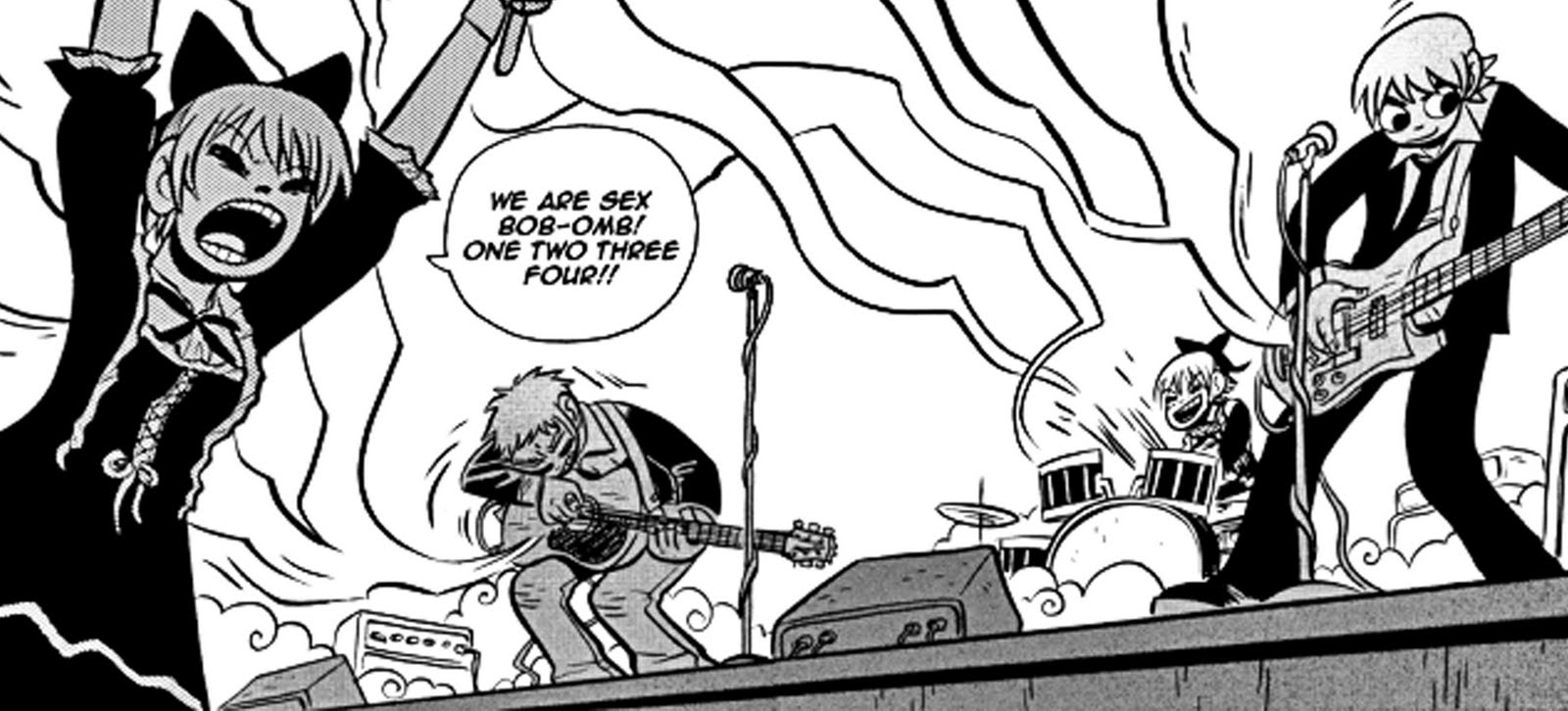
Panel from Bryan Lee O'Malley's Scott Pilgrim.


IIt’s a universal truth that the movie is always worse than the comic on which it was based, and Scott Pilgrim vs. The World—the latest and greatest Michael Cera vehicle—is no exception. Bryan Lee O’Malley’s Oni Press cult hit Scott Pilgrim is superior by far. Fortunately, however, O’Malley’s comic is terrific enough that SPVTW still manages to be a decent, if sometimes facile, film.

I know, I know. Any self-respecting, young-ish cultural critic is supposed to have long ago turned against Michael Cera and, by extension, any film in which he appears. Maybe it was Juno; maybe it was the rumors (unsubstantiated though they may be) that his holding out for more money is the cause of death of the Arrested Development movie. I think Gawker, however, put it best: Cera has “reveal[ed] the hipster machinery a little too openly for any self-respecting hipster to admit to be fooled by.” And as the swarm of fixie-riding, grandma glasses-wearing, Brooklyn-worshiping twenty-somethings go, so goes the nation. And so, SPVTW has shared the same cruel fate as the very-watchable Nick and Nora’s Infinite Playlist, the nearly unwatchable Paper Heart, and the simply unwatched Youth in Revolt; viz., no one went and saw the poor thing.

But if there’s a movie to showcase Cera’s, let’s say unique, talents, it’s SPVTW. Sure, Cera is the Coldplay of actors: His songs sound exactly the same, but the song he plays over and over again isn’t that bad. And in the case of SPVTW, the eponymous character is a half-assholic, half-hapless twenty-something whose main redeeming trait is a sort of detached, if winning, awkwardness. I think someone’s playing Cera’s song.

Even better: One of the distinguishing—indeed, noteworthy—traits of SPVTW (and the comic by the same name) is that the arc of the protagonist moves not from awkward-but-hapless to awkward-but-brave, but rather awkward-but-assholic to awkward-but-less-assholic. Let me put it another way: Michael Cera is no Zach Braff, and SPVTW is no Garden State.

Even better-er: The main female protagonist of the film, Ramona Flowers (sadly, the only mis-casting in an otherwise perfectly-cast movie), is no Natalie Portman. Of course, compared to the comic, the Flowers of the film is little more than a hollow shell of her comic book counterpart, but compared with other Manic Pixie Dream Girls, Flowers is frackin’ Shakespearean.

It’s worth pointing out that, unlike the comic, the movie doesn’t past the Bechdel Test—a test made famous by Alison Bechdel’s comic Dykes to Watch Out For. (For the uninitiated, the Bechdel Test is this: One should only see a movie that has (1) at least two women in it (2) who talk to each other (3) about something other than a man.) The female characters suffered the most from the inevitable cuts to and Hollywoodization of the comic, which is a travesty considering O’Malley’s nuanced depictions. Indeed, SPVTW’s failure to pass the Bechdel Test is representative of the main problem with the film: O’Malley’s comic spanned over 1,200 pages and three years, while SPVTW sliced that down to an hour and change and three weeks.

But despite the sometimes-brutal cuts and basterdizations, SPVTW still managed to shine. It helps that the dialogue is largely taken verbatim from the comic and that Beck wrote half of the music. Plus, if the movie had a face, it would kiss the casting director on the lips.

The real triumph of SPVTW is that it manages to take the tropes and trappings of hipsterdom and fill that nihilism with earnestness. Indeed, the final boss (Jason Schwartzman at his best—excepting Rushmore) gets his ass kicked after proclaiming his allegiance to cutting-edge taste, declaring, “I’m hip; I’m what’s happening; I’m what’s blowing up now.” That’s right, the movie’s penultimate scene is Michael Cera beating up the biggest hipster ever.

Self-aware without being self-conscious, refreshingly fun but not vapid, Scott Pilgrim vs. the World is worth seeing on the silver screen—even if, as a character in the movie admits, the comic’s much better.

Saturday, July 24, 2010

This Bee Can Sting


I asked a friend of mine for a book recommendation, and, recommendation in hand, I trucked down to Birchbark Books (a local bookstore in Minneapolis, owned by Louise Erdrich--and if you're ever in the Lakes area in Minneapolis, you ought to stop in for a visit) and picked up Little Bee, the sophomore novel by Chris Cleave.

Written with all the contemporary bells and whistles (shifting narrators, thematic obsession, etc.), Little Bee tracks the its titular character's (Little Bee) struggle to find asylum in the U.K., and the life of a recently widowed reporter-turned-Cosmo smut peddler. They meet, of course, and they share a past, of course, and the result is a wonderful tragedy (in the broad sense). There's even a stand-in for a Greek Chorus; what's not to love?

It's heartbreaking at time: What else would you expect from a book about a 16-year-old Nigerian undocumented immigrant fleeing machete-wielding death? Fortunately, Cleave's wit and black humor is some of the best I've seen:

I have never been one of those happy women who insist that disaster strikes from a clear blue sky. For me, there were countless foretellings, innumerable small breaks with normalcy. Andrew's chin unshaved, a second bottle uncorked on a weekday night, the use of passive voice on deadline Friday. Certain attitudes which have been adopted by this society have left this commentator a little lost. That was the very last sentence my husband wrote. In his Times column, he was always so precise with the written word. From a layperson, lost would be a synonym for bewildered. From my husband, it was a measured good-bye.

Witty? yes. A disarming love of (obsession with?)language befitting a contemporary novelist? yes. Not black humor though, so here's this, from the mouth of Little Bee:

There are things the men can do to you in this life, I promise you, it would be much better to kill yourself first. Once you have this knowledge, your eyes are always flickering from this place to that, watching for the moment when the men will come. [...]

One day the detention officers gave all of us a copy of a book called LIFE IN THE UNITED KINGDOM. It explains the history of your country and how to fit in. I planned how I would kill myself in the time of Churchill (stand under bombs), Victoria (throw myself under a horse), and Henry the Eighth (marry Henry the Eighth). I worked out how to kill myself under Labour and Conservative governments, and why it was not important to have a plan for suicide under the Liberal Democrats. I began to understand how your country worked.

I laughed out loud, and before I could feel bad about laguhing at suicide plans, I dove back in. A good trick: make 'em laugh but feel bad for laughing. The only thing to do is read on.

Another:

"I think I shall teach you the names of all of the English flowers," said Sarah. "This is fuchsia, and this is a rose, and this is honeysuckle. What? What are you smiling about?"

"There are no goats. That is why you have all these beautiful flowers."

"There were goats, in your villiage?"

"Yes, and they ate all the flowers."

"I'm sorry."

"Do not be sorry. We ate all the goats."

Another:

I mean look," he said. "There's eight million people here pretending the others aren't getting on their nerves. I believe it's called civilization."

Also, keep your eyes peeled for a delicious--but too long--joke about a taxi driver, David Bowie, and the multiple meanings of the word 'cock.' I haven't laughed so hard in ages.


Of course, the book isn't all black comedy. And though it uses pomo literary techniques, it falls prey to none of the masturbatory vanity on display in many of those works. Indeed, Little Bee stays grounded because despite all the language games textual awareness, it contains an emotional and thematic core to strong to be caught up in the shifting currents of Theory.

In an interview (helpfully, and obnoxiously included at the end of this book. I'm fairly certain I dislike the practice of including, generally useless, information in the back of books. It makes me feel as though I'm being talked down to by the publishers, but I digress...), Cleave says:

[H]ere's the true story that inspired me to write Little Bee. In 2001, an Angolan man named Manuel Bravo fled to England and claimed asylum on the grounds that he and his family would be persecuted and killed if they were returned to Angola. He lived in a state of uncertainty for four years pending a decision on his application. Then, without warning, in September 2005, Manuel Bravo and his thirteen-year-old son were seized in a dawn raid and interned at an Immigration Removal Centre in southern England. They were told that they would be forcibly deported to Angola the next morning. That night, Manuel Bravo took his own life by hanging himself in a stairwell. His son was awakened in his cell and told the news. What had happened was that Manuel Bravo, aware of a rule under which unaccompanied minors cannot be deported from the UK, had taken his own life in order to save the life of his son. His last words to his child were: "Be brave. Work hard. Do well at school."

This may be unfair, but, as a general rule, it is easy to play language games and call it a day when you're writing about your own existential crises; it's much harder to base a book on some foundation-less, ever-shifting mire of words when you're writing about a man who kills himself to save his son.

(And not to be glib, but I find in horrible and hilarious that the very next question in the interview is "What can we expect next from you?" I honestly can't fathom hearing about the plight of Manuel Bravo, and then asking about "What's next?" Let's hope the interview is heavily edited.)


If you're interested, I do recommend the book. It's all of those adjectives you read on the back of books. It's also a perfect example of how to use the devices of pomo lit for good. Huzzah!

A reminder: I get paid if you buy a copy by clicking on the link up top. Rest assured, I dislike a great deal of what I read, though I probably won't write about those, so I'm not just talking up Little Bee to make a quick buck (keeping in mind that my checks include fractions of pennies). If you have the good fortune of living near a small bookstore like Birchbark, then don't buy Little Bee (or books in general) from Amazon/Me; buy your books from the corner shop, and make the world a better place.

Saturday, July 10, 2010

The Trouble with Consequentialism

There's an interesting back-and-forth going on between Tyler Cowan over at Marginal Revolution and Robin Hason at Overcoming Bias.

It all started with this post by Cowan on cryonics; after quoting a piece in The New York Times one couple's martial disputes over whether or not to freeze themselves to prevent their deaths, he writes:

My question is: why not save someone else's life instead?

He later elaborates on that rather glib pronouncement:

A few of my lunch compadres have asked why I compare cryonics (unfavorably) to acts of charity, rather than comparing other acts of personal consumption (I enjoy the gelato here in Berlin) to charity. My view is this: the decision to have one's head frozen is not primarily instrumental but rather expressive. Look at the skewed demographics of the people who do it, namely highly intelligent male readers of science fiction, often with tech jobs. Is it that they love their lives especially much? Unlikely. Instead it's a chance to stand for something and in a way which sets them apart from many others. It's a chance to stand for instrumental rationality, for Science, for attitudes which go beyond traditional religion, for the conquering of limits, for probabilistic reasoning, and for the notion that the subject sees hidden possibilities and resources which more traditional observers do not. [...]

I believe the world would be better off, and the relative status of the virtuous nerds higher, if instead the cryonics customers sent more signals which were perceived as running contrary to type. Ignoring cryonics, and promoting charity, would do more to raise the status of intelligence and analytical thinking than does cryonics.

On the practical side, while I am a non-believer, I also think that charity has a greater chance of bringing a longer life to one's self -- or immortality -- than does signing a cryonics contract. That's an even stronger triumph for probabilistic thinking than what the cryonics customers have on tap.

Robin Hanson responds:

Tyler’s argument is hard to follow here. Is he merely saying the world is better if anyone acts more contrary to type, expresses less relative to instrumenting, or donates more to charity? If so, why pick on cryonics and tech nerds in particular, why not just rail in general against all expressing, typed-acts, and non-charity? If the argument is that the world gains unusually more from tech nerds acting against type, expressing less, and giving to charity, then we need to hear an argument for that. It certainly seems odd to complain that tech nerds, usually critiqued for being overly practical, are actually overly expressive.

Let’s be concrete. Tyler goes way out of his way to be, and call attention to his being, a “foodie” – his eating a gelato in Berlin, and then mentioning on his blog, clearly has a big expressive component. Being a foodie lets Tyler join a high status community and stand for art, culture, etc. in a way that sets him apart and supports the notion he can see hidden food quality that the rest of us do not see. (I like “great” food, but honestly not much more than ordinary food.) Does Tyler think the world would be equally better off if foodies were to act contrary to type, express less via buying less fancy food, and give the difference to charity? If so, why has he never mentioned it in his hundreds of food posts?

Could it be Tyler knows that tech nerds are low status in our society and fair game for criticism? Is this really any different than rich folks complaining about inner city kids who buy $100 sneakers instead of saving their money or giving it to charity, even while they buy $1000 suits and dresses instead of saving their money or giving it to charity?

Finally, Cowan makes this rather half-assed response:

This is not essential to the points under discussion, but I should add that I consider tech nerds to be a relatively high status group in American society, at least above the age of thirty.

Time for my rather half-assed gloss.

First of all, I agree with Cowan in that Hanson's bitching about tech nerds' low status is a lot of bitching over nothing. That said, I think that Cowan's elaboration on his first pronouncement does little to change the fact that's difficult to read

My question is: why not save someone else's life instead?

as anything other than an unfriendly moral evaluation on freezing oneself.

Cowan's argument that the decision to freeze oneself is somehow expressive, and therefore subject to a greater moral burden than merely instrumental places a lot of weight on a distinction that can't take much weight at all.

I'm not sure that one can say any decision regarding consumption isn't in a way expressive. You don't have to be a fan of Pomo to read actions as identity forming, and therefore, in some sense expressive.

I agree with Hanson that Cowan's decision to eat gelato is different only in scale than some nerd's decision to freeze oneself.

At the end of the day, all of this back-and-forth is a consequence, if you'll pardon the pun, of consequentialism. If you're only real moral objective is to maximize good, then you're going to wind up with constant problems of resource allocations--in a trivial sense (obviously there are plenty of serious moral resource allocation problems, but I'm not sure the decision to eat gelato counts).

One of the classical problems with consequentialism is that if one is trying to maximize good, one can always do more. Why is it that we don't all do only what one can to subsist and give the rest to charity?

Wednesday, June 23, 2010

Irony

Ezra Klein gives us "how a bill becomes a ironic" (here):

House Democrats are now saying that the rules would also exempt the AARP and Humane Society, though it doesn't seem like anyone knew that this morning (and it doesn't appear that either group asked for the exemption). To make the obvious point, there's really no reason that any of these interest groups should be exempt from the new disclosure requirements. The only reason that they're getting this consideration is, well, that they're powerful interest groups and powerful interest groups receive undue consideration from lawmakers. Which is exactly what the DISCLOSE Act is supposed to prevent. And that, kids, is how a bill becomes an irony.

Sunday, June 20, 2010

This Is Comics Criticism

I just wrapped up reading Phonogram: The Singles Club, a seven-issue miniseries by Kieron Gillen and Jamie McKelvie. The Singles Club is the second volume to bare the Phonogram name. I haven't read the first.


By some stroke of blog-happenstance, right after I finished Phonogram, I decided to start to make my way though the 500-odd unread posts on my RSS reader to which I had yet to get. Well, I'm here to tell you, Brian over at Bubblegum Aesthetics is back in a big way with a wonderful post on the first, six-issue run of Phonogram:

Originally published by Image as a six-issue, black-and-white miniseries in 2006 (with a follow-up miniseries"sequel"--actually individual stories set in the same magical universe--released last year), Phonogram opens with quick glances at a set of signifiers--reflecting dark-rimmed glasses, just-so haircut, leather jacket, and the all-important lighter-'n'-cigarettes--whose fetish qualities are enhanced by their capture in individual, unconnected frames. This is our lovable anti-hero David Kohl (in his own self-description, "Toxic and male. Utterly noxious. Totally perfect") getting ready for the evening, and these early panels immediately keys into the ways pop music can both deconstruct our identities as commodified consumers (we are what we wear), and rarify those same impulses (we are, simultaneously & gloriously, both stand-out individual and blissed-out member of a community).

...

There have been many times in this post when I've accidentally typed "writer" instead of "reader," and I think that's McKelvie and Gillen's great magic trick: in the more active use spaces of pop music, DJing, comics and blogging, the reader is invited to be both creator and receiver of meaning, to remix and simulate the groove of the song on the comic book page and in his head. As we read, our pleasure becomes blurred.

There's something banal, I suppose, for me to say that comics are, in some sense, emblematic of this generation. Comics break down the sticky artistic dichotomies between image and text, form and content, high and low art so efficiently; it's hard not to see comics as the easiest vehicle for the kind cultural themes we've created for ouselves.


The Vertigo "meta" lineup (viz., Air, Fables, House of Mystery, The Unwritten) has, perhaps more than any other group of contemporary comics, thrust the medium into the realm of artistic self-reflection. What makes Phonogram different is the way in which it gets to that place: pop music. (It's worth noting that Blue Monday and Scooter Girl took stabs at something like this, but with much less sophistication.)


For the record, Phonogram has a history on this blog. Said Marc a few months back:


We need more comics like PHONOGRAM or CASANOVA. We need more comics that hold up under scrutiny, but still get in your blood and make it fucking move.

...

And that’s precisely the point of PHONOGRAM: It explores the ways in which music shapes our lives, the ways in which we live inside music, process it, and parse that out in our everyday interactions.

I'd go further: It's explores the ways in which we inhabit the "pop" forms in general; as Brian says, "In the more active use spaces of pop music, DJing, comics and blogging, the reader is invited to be both creator and receiver of meaning, to remix and simulate the groove of the song on the comic book page and in his head."


I might go even further, and point out that the act of writing about comics is a sort of engagement in the cultural processes with which Phonogram deals. I'll let Brian take us out (from his article in Wilder Voice a few years back):

And perhaps the ultimate coming together of comics, Truffautian manifestos, and technology is the Internet, where hundreds of comics blogs are re-imagining the rules of fandom, criticism and creativity for a post-Cold War age. In contrast to the detailed history of Hadju or the remembrance-bordering-on-hagiography of Evanier’s Kirby book, the comics blog surfs, providing a mix of snark, social commentary, short and long forms, and often dazzling plays with image/text mixing. Sturgeon’s Law states that “ninety percent of everything is crap,” and more than any other contemporary media, blogging seems to be perceived this way. I wouldn’t deny the odds (although I might lower them to, say, fifty percent), nor exclude blogs from them. But such complaints do feel like something of an arrière garde action, an attempt to defend old (and perhaps timeworn) discourses in the face of the new technology. Rather than dismiss it out-of-hand, it feels far more interesting to think about what possibilities it presents (just as Truffaut and Kirby’s challenges did so many years ago). Rather than comic book as criticism, we might begin to imagine the blog space as reversing that equation: in its third form of writing, imagery and video, it can become criticism as a comic book.


Monday, February 15, 2010

whoops


Whoops.

I have missed a number of mistakes in my tenure as Grape copy editor and Wilder Voice managing and editor-in-chief. I've even let in embarrassing spelling mistakes in titles and subheaders. And, I know I shouldn't gloat, and I have several friends at The Review (including the production manager), but it's nice to know that the Oberlin paper of record makes a mistake now and again.


Let me say too, The Grape has on more than one occasion published flat out libel, racism, and porn.


Ah, the wonderful world of college journalism.

Wednesday, February 10, 2010

Masquerade Theatre


The Boston Tea Party

In the December 2008 issue of Harper's, Garret Keizer penned a piece that would prove prescient, "Of Mohawks and mavericks," the first three paragraphs of which I'll reprint here (though you really should go read the whole thing):


I have never gotten over the notion that the history of the United States begins with an act of masquerade. On the night of December 16, 1773, “a number of resolute men (dressed like Mohawks or Indians),” as later reported in the Boston Gazette, managed to dump some 90,000 pounds of East India Company tea into Boston Harbor. They did this, again as reported by the Gazette, “to save their country from the ruin which their enemies had plotted.” From a distance it is hard to say which disguise was the more outlandish, that of the local merchants got up as Hiawatha or that of a beverage tax got up as the tyrant’s scourge. To come even close you would have to dress up a million- dollar-a-month AIG booty bag as a “consulting fee.”

The Tea Party proved catalytic—one book devoted to the episode bears the title The Night the Revolution Began—and prophetic as well. Americans have been dressing up ever since: Ku Klux Klansmen costumed as ghosts, ghost-white college kids posing as homeboys and Rastas, corporate lawyers decked out in Stetsons and cowboy boots, Wall Street sharpies affecting the flabbergasted expressions of sucker-punched rubes (“That thar’ mortgage thingamajig done blew itself up”). Add an extra touch of fantasy to the makeup and you get Ronald Reagan as the savior of democracy and John McCain as the patron saint of reform. J. Edgar Hoover may never have stood so resolutely for the American way as in those legends that have him flinging a boa round his neck and prancing before his full-length mirror in drag.

Numerous studies have been written on the role of masking in traditional cultures, but they throw little light on the false-face societies of the United States. Probably no one theory could account for our every disguise, for Al Jolson in blackface and Rush Limbaugh as the aggrieved common man. I suspect that aside from the obvious explanations—the fun of dressing up, the benefits of anonymity as you hatchet open chests of tea—the main reason we mask ourselves is to hide from the claims of common life, which is to say, the claims that taxation in its purest form attempts to address. The partisan badge, the counterculture face paint, creates the illusion of membership in something less dull and burdensome than the whole human race. Against the reality of our shared need for food, clothing, and shelter, education, health care, and meaningful work—and the gross inequality of our current portions of the same—we construct a fable of society as a vast ecosystem of diverse species, each with its niche and unique preferences, the top dog and the bottom-feeder apportioned their various integuments for reasons known only to Darwin or God. The iconic communal table of the first Thanksgiving thus gives way to the cantina scene in Star Wars, with special effects that are truly (and politically) out of this world, including recent cameo appearances by John McCain as Obi-Wan Kenobi and Sarah Palin as Princess Leia.

And now, as the "tea party" movement gains steam, we are treated, once again, to an act of masquerade. Men and women dress up and play revolutionary, fighting for "freedom." Freedom for property and not for people.


Men and women who believe themselves to be an abused bloc, but actually recieve more consideration than most. Consider the latest fracas, brought to my attention by Marc (via Comic Book Resources):


Marvel Editor-in-Chief Joe Quesada says that while he can understand why some people are upset by a "tea bag" reference in Captain America #602, he thinks "there’s also a portion of this story that is being blown out of proportion and taken out of context."

Some members of the Tea Party movement are offended by a scene in the January issue, Part 1 of the "Two Americas" storyline, which depicts an anti-tax rally in Boise, Idaho. Among the protesters is a sign that bears the slogan, "Tea Bag The Libs Before They Tea Bag YOU!"

The offending panal (here):


Of course, this is much ado over nothing (but Fox is all over it). The sign is a direct copy of a sign that actually appeared at a Tea Party rally (here):


This speaks to a larger masquerade: the entire Tea Party movement is nothing but a masquerade. They are upset over a sign actually made by one of their own, and they can be because the term 'Tea Party movement' refers only to what you want it to at a certain point. Says Jesse Taylor at Pandagon:


Melissa Clouthier writes what’s become the standard Tea Party trope: the Tea Party is not responsible for anyone associated with the Tea Party, because no Tea Partier ever has to be associated with things they don’t like. In fact, it’s the central tenet of the Tea Party movement: no Teabagger is responsible for that except which he or she personally deigns to Teabag, and no true Teabagger would ever do something that whatever Teabagger is speaking doesn’t like.

Sarah Palin’s not a “leader” of the movement, because the movement has no leaders; it just has contributors. In a way, they’re like a living, breathing version of Marx’s dictatorship of the proletariat, except that they’re lying because folks like Palin, Limbaugh and Beck are all very clearly leaders of the movement and Marxists were almost certainly saner than most Tea Partiers.

But it speaks to the inherent power of the Tea Party’s postmodern incoherence. It’s a movement which claims millions but for which each member can deny every other member’s validity as a member per se, yet also make up that all those other people whose affirmative beliefs they deny in fact believe something else which reintegrates them back into the whole. It’s like the Borg, if the Borg operated by Calvinball rules where they could just land on a planet, point at a tree, a ceiling fan and a stereo playing Phil Collins and simply say “All of this - Borg”.

And of course it's a masquerade because no one really knows what liberal and conservative are anymore; certainly the modern body politic, sick as it is from Self-Satirizing Syndrome, couldn't tell one from the other.


The key difference between liberal and conservative--not, you'll note, Democrat and Republican--is twofold: (1) how narrowly or broadly she defines "public good" and the (2) emphasis placed on property versus personal freedom.
First, the conservative defines "public good" narrowly: in her view the government should supply only the most bare-bones services and ignore--or slough off onto the private sector--the rest. The liberal, however, defines "public good" broadly: in her view, the government should do much more to ensure strong communities and social fabric.


Second, the conservative places a premium on freedom of property: coercive taxes are a constraint on freedom, and that should be avoided. The liberal, on the other hand, places a premium on personal freedom: Inequity ravages communities and preys on the already-downtrodden, and in order to ensure their access to the American dream we need to provide services.


I had two illuminating conversations recently. The first was with my parents. They were deploring the recent cut in services in Minnesota, which will almost certainly lead to the deaths of hundreds--if not thousands--of people. They called it murder. I wasn't so sure. After all, I said, proximity matters, and Governor Pawlenty and the State Legislature isn't going around shooting the homeless. And, of course, the removal of services isn't murder, it's manslaughter. Both points, cold as they are, I still think have merit, but there's more to it than that.


Murder or manslaughter, it makes no difference. There is blood shed in Minnesota--in every corner of the country--because our country places and emphasis on property rights. That blood is on the hands of every community, no matter how hard individual members may struggle against the decline in services.


The second conversation was at a recent dinner party. We were debating the pros and cons of missionary work. I took the rather extreme position that, despite the good religion can do, we now have secular ways of organizing communities--ways that do not include epistemological mis-steps. My friend Mike, however, pointed to Liberation Theology, Archbishop Romero, and a host of other religious movements that have done so much good for so many people.


I relented, if only a little, allowing that religion is a potent community-maker, and, as such, a potent way of providing relief--more potent, perhaps, than secular civic institutions. Upon further reflection, I think I need to go a bit further; when secular civic institutions fail as heartily as they have in this country, we have an obligation to pursue whichever ways we can to salvage our community. Perhaps our own country could use a health dose of "missionary" work.


When men die of exposure in Minneapolis, when women choose between health care and food and rent, when our communities fail to fund schools and hospitals, we require something more; we need a way to rebuild our communities.


Garret Keizer writes: "I have never gotten over the notion that the history of the United States begins with an act of masquerade." I have never gotten over the notion that the history of the United States begins with an act in defense of property rights. Well, we started there, let's see where we go from here.

Thursday, January 28, 2010

I Want One/I Don't Want One


I'm a sucker for Mac products, and I would certainly give it a good review if Apple decided to send me a free iPad.


That said, my friend KY is right on with this one:


New Thing: Anyone who says "I want a iPad" will get the response "Why, do you have your iPeriod?

Perhaps Apple should consider having some women work in their Dept. of Putting i in Front of Things. Just sayin'.


I'm also a bit perturbed that you still can't play flash on the iPad (or, for that matter the iPhone). I find it a little feudalistic that we have to watch internet TV in Apple-approved ways.


Along similar lines, Devilstower, over at Daily Kos, brought up an interesting--and disturbing thought:


Just as the web replaced earlier systems, Apple is building an alternative ecosystem that uses the Internet's backbone covered with their own cross-device platform. The early focus of that system has been on media. They've successfully built a massive presence in music even though everyone predicted their failure ("who is going to pay to download music when you can get it for free?"). They've called their entrance into television and movies a "hobby," but it's a hobby that outstrips all competitors. Even the little application store for the iPhone, which gave every appearance of being an afterthought, has turned into a revenue stream of around $5 billion a year.

Tablet or not, odds are that this week will see Apple's entry into books and magazines. The bow wave of that pending event is already reshaping everything from how much the New York Times is willing to give away on their web site to what Amazon pays in ebook royalties. When this wave has passed, there's every chance that a lot of people will make their way through the Internet without ever seeing the letters "www" again. It won't be the web. It'll be the Orchard.

There's a certain disturbing logic to this, but I'm not sure how likely it is that Apple's foray will result in a ghettoized internet. After all, Hulu made it possible for me to be a more discriminating consumer when it comes to iTunes. Now, instead of not buying a show off iTunes because I'm not sure I'll like it, I can watch a show on Hulu and decide if it's something worth rewatching. In this way, the two internets become connected, enhancing each other.


The arc of the internet bends toward freedom, and I have a hard time imagining that Apple by its lonesome can invert that arc. But maybe I'll hold off until Apple comes out with an open souce iPad.

Tuesday, January 26, 2010

Morning Update XXVIII: The Dead Tree Edition


McSweeney's Issue 33
The San Francisco Panorama
Here.

Over at The Columbia Journalism Review, Miles Corbin pens a fascinating look at the journalism of the young Gabriel García Márquez (via Ezra Klein at The Washington Post):

In 1955, eight crew members of a Colombian naval destroyer in the Caribbean were swept overboard by a giant wave. Luis Alejandro Velasco, a sailor who spent ten days on a life raft without food or water, was the only survivor. The editor of the Colombian newspaper El Espectador assigned the story to a twenty-seven-year-old reporter who had been dabbling in fiction and had a reputation as a gifted feature writer: Gabriel García Márquez.

The young journalist quickly uncovered a military scandal. As his fourteen-part series revealed, the sailors owed their deaths not to a storm, as Colombia’s military dictatorship had claimed, but to naval negligence. The decks of the Caldas had been stacked high with television sets, washing machines, and refrigerators purchased in the U.S. These appliances, which were being ferried to Colombia against military regulations, had caused the ship to list dangerously. And because the Caldas was so overloaded, it was unable to maneuver and rescue the sailors.

In addition, the life rafts on board were too small and carried no supplies, and the Navy called off the search for survivors after only four days.

By the time the series ended, El Espectador’s circulation had almost doubled. The public always likes an exposé, but what made the stories so popular was not simply the explosive revelations of military incompetence. García Márquez had managed to transform Velasco’s account into a narrative so dramatic and compelling that readers lined up in front of the newspaper’s offices, waiting to buy copies.

I think the public may have just liked all the really graphic and awkward descriptions of underage sex.


I joke, I joke.


Intrigued? Go, read.


You may or may not have heard that San Francisco is without a newspaper. Oberlin has three; suck it San Fran! McSweeney's, a literary journal based in San Francisco, is also responsible for The Believer and McSweeney's Rectangulars, a publishing company.


Well, now, they've published a 320 page love letter to the newspaper industry: a full Sunday issue of a non-existent newspaper, and it's one of the more interesting reads I've had. I haven't finished it, but it's sitting on my table, and every day I read a few more pages. It's absolutely fascinating.


Of course, it isn't a viable business model--it cost about $20, which is probably a little more than people are willing to pay for a newspaper daily. Of course, there is something to what they've been doing. Full, two broadside-sized sheet spreads with images and diagrams are something you can't get on the internet. Large-scale design and layout are things you can't get on the internet.


If the newspaper industry is going to survive in dead-tree form, then they need to have things that the internet can't have.


Intrigued? Go to the library and read.


Speaking of San Francisco newspapers, I read Richard Rodriguez's amazing essay in the November 2009 Harper's about the rise and fall of the San Francisco newspaper. It's part memoir, part historical essay, and part elegy, and, since it's Rodriguez (who also wrote Brown and a host of other good books), its prose is unfailingly moving.


He writes:


A scholar I know, a woman who is ninety-six years old, grew up in a tin shack on the American prairie, near the Canadian border. She learned to read from the pages of the Chicago Tribune in a one-room schoolhouse. Her teacher, who and no more than an eight-grade education, had once been to Chicago--had been to the opera! Women in Chicago went to the opera with bare shoulders and long gloves, the teacher imparted to her pupils. Because the teacher had once been to Chicago, she subscribed to the Sunday edition of the Chicago Tribune, which came on the train by Tuesday, Wednesday at the latest.

Several generations of children learned to read from that text.

Beautiful, yes. Sentimental, yes, but not altogether illuminating on what it means to have--or not have--a newspaper. Of course, that's just the opening paragraph. There's more:


The day after I was born in San Francisco, my tiny existential fact was noted in several of the papers that were barked through the downtown streets. In truth, the noun "newspaper" is something of a misnomer. More than purveyors only of news, American newspapers were entrusted to be keepers of public record--papers were daily or weekly cumulative almanacs of tabular information. A newspaper's morgue was scrutable evidence of the existence of a city. Newspapers published obituaries and they published birth announcements. Thy published wedding announcements and bankruptcy notices. They published weather forecasts (even in San Francisco, where on most days he weather is optimistic and unremarkable--fog clearing by noon). They published the fire department's log and high school basketball scores. In a port city like San Francisco, there were listings of the arrivals and departures of ships. None of this constituted news exactly; it was a record of a city's mundane progress.

Two things of note. (1) Go mimesis! (2) This function can be much more easily accomplished on the internet. Unfortunately, to aggregate it requires resources. Who has the resources to do such a thing now? He continues:


In the nineteenth-century newspaper, the relationship between observer and observed was reciprocal: the newspaper described the city; the newspaper, in turn, was sustained by readers who were curious about the strangers that circumstance had placed proximate to them. So, I suppose, it is incomplete to notice that the San Francisco Chronicle has become remiss in its obituary department. Of four friend of mine who died recently in San Francisco, not one wanted a published obituary or any other public notice taken of his absence. This seems to me a serious abrogation of the responsibility of living in a city and as good an explanation as any of why newspapers are dying. All four of my friends requested cremation; three wanted their ashes consigned to the obscurity of Nature. Perhaps the cemetery is as doomed in America as the newspaper, and for the same reason: we do not imagine death as a city.

We no longer imagine the newspaper as a city or the city as a newspaper. ... We might now say: Newspapers will be lost because technology will force us to acquire information in new ways. In that case, who will tell us what it means to live as citizens of Seattle or Denver or Ann Arbor? The truth is we no longer want to live in Seattle or Denver or Ann Arbor. Our inclination has led us to invent a digital cosmopolitanism that begins and ends with "I." ... The cost of my cyber-urban experience is disconnection from body, from presence, from city.

...

Another friend, a journalist born in India, who has heard me connect newspapers with place once too often, does not dispute my argument, but neither is he troubled by it: "If I think of what many of my friends and I read these days, it is still a newspaper, but it is clipped and forwarded in bits and pieces on email--a story from the New York Times, a piece from Salon, a blog from the Huffington Post, something from the Times of India, from YouTube. It is like a giant newspaper being assembled at all hours, from every corner of the world, still with news but no roots in a place. Perhaps we do not need a sense of place anymore."

So what is lost? Only bricks and mortar. (The contemptuous reply.) Cities are bricks and mortar. Cities are bricks and mortar and bodies. In Chicago, woman go to the opera with bare shoulders.

I hope my excessive excerpting, clips and all, retains some of the beauty and insight of Rodriguez's essay. For that matter, I hope it retains status as fair use.


I remember, growing up, that The Minneapolis Star-Tribune would come on rainy days wrapped in plastic bags: blue, white, or yellow. We used those to pick up our dogs shits when we took him on walks. I remember they would come bound by a rubber band, and we would peel the band off and keep it next to the innumerable others in a drawer--the only real record of receipt that stood the test of time. We still have a drawer with rubber bands--hundreds maybe. Except the Sunday issue--it was too big to use a rubber band. It came heavy and flat, and carrying it in with my young and untrained hands, I would often let sections drop from the middle--coupons and comics and supplementals.


I remember on summer mornings, my father would take the paper outside on the deck and read it and eat his cereal. I remember the spats over who gets which section. My mother always felt my father took the A section too quickly. My father would slink away with it. When caught, he gave it up and took the business section. Sometimes, he took the crossword, which only made the situation worse.


What does it mean that Oberlin has three papers? Freshman year, my friend Ellen partied until she vomited, and Safety and Security came and made sure she was all right. When The Oberlin Review came out, she clipped her entry in the Security log and taped it to her wall. It became a ritual for us all.


Perhaps place and paper are interconnected and perhaps newspapers make cities as much as cities make news.


Techno-puritanism that wars with the body must also resist the weight of paper. I remember that weight. It was the weight of the world, carried by boys.

...

In the growling gray light (San Francisco still has foghorns), I collect the San Francisco Chronicle from the wet steps. I am so lonely I must subscribe to three papers--the Wall Street Journal, the New York Times, the San Francisco Chronicle. I remark their thinness as I climb the stairs. The three of them together equal what I remember.

Intrigued? Go, read (it may be subscription only, in which case go to a library; it's worth it).

Sunday, January 17, 2010

Are We Gadgets?


You Are Not a Gadget
Jaron Lanier

Well, Tyler Cowan and I have been reading the same thing (in different places, though). Jaron Lanier's latest book, You Are Not a Gadget, recently came out and has sparked some controversy. It was excerpted in the most recent Harper's (where I found it). The thesis seems to be that the social media, and the internet 2.0 (or are we at 3.0, now?) in general rather than giving agency to people is forcing them to subsume what little agency they have to an internet hive mind. I disagree, of course, but it's interesting stuff. Representative quote:


If money is flowing to advertising instead of to musicians, journalists, and artists, than a society is more concerned with manipulation than with truth or beauty. If content is worthless, then people will start to become empty-headed and content-less. The combination of hive mind and advertising has resulted in a new kind of social contract. The basic idea of this contract is that authors, journalists, musicians, and artists are encouraged to treat the fruits of their intellects and imaginations as fragments to be given without payment to the hive mind. Reciprocity takes the for of self-promotion. Culture is to become precisely nothing but advertising.

I feel... pierced. I will now take the next seventeen seconds to reevaluate my life.


I'm back. Here's more.


I know quite a few people, most of them young adults, who are proud to say that they have accumulated thousands of friends on Facebook. Obviously, their statements can be true only if the idea of friendship is diminished.

...

Under the No Child Left Behind act of 2002, for example, U.S teachers are forced to choose between teaching general knowledge and "teaching to the test." The best teachers are thereby disenfranchised by the improper use of educational-informational systems.

What computerized analysis of all the country's school tests has done to education is exactly what Facebook has done to friendships. In both cases, life is turned into a database. Both degradations are based on the same philosophical mistake, which is the belief that computers can currently represent human thought or human relationships. ... When technologists deploy a computer model of something like learning or friendship in a way that has an effect on real lives, they are relying on faith. When they ask people to live their lives through their models, they are potentially reducing life itself.

Phew. It's interesting stuff, make no mistake. But it's an unflaggingly negative view of things that have plenty of positive upshots. That said, there's something to his critique of computer modeling, particularity when seen through a philosophy of science lens. That is: models are not truth apt; they can not be true or false, they can only be useful or not useful. A model of an atom is useful if we can use it to learn about how real atoms behave. A model of education is useful if we can use it to learn about how real people learn. A model of friendship is useful is useful if we can use it to learn how people behave in friendship. None of these things indicate that NCLB is a true account of education or that Facebook is a true account of friendship. Clearly, it's a mistake to think that they are; indeed, the entire idea that they could be is incoherent. Models are not truth apt. The mistake isn't in the existence of Facebook or NCLB (though the latter is debatable); the mistake is in taking what they tell as something that can be true or false. (Similarly, the mistake isn't in the existence of economics; the mistake is in taking what economics tells us as being true or false--it's useful or not useful.)


When seen through this light, though, the answer to the problem Lanier has brought up isn't that we should look negatively at Facebook; it's that we should look negatively at how people use or mis-use Facebook. Let's not throw the baby out with the bathwater.


Intruiged? Go, read (or, read).

Wednesday, December 9, 2009

Bad Girls


not all vampire flicks are created equal...

It's been a while since I read Amanda Marcotte's stuff on Pandagon, but all this business with conservatives and their irrational hatred of climate science has managed to pull me back over. And, since Marc gave me a column, I thought join him on his hobby horse.


I don't really have much to add, but here's a teaser from Marcotte's excellent post on Twilight and the state of feminism:


Jonathan Zimmerman has a theory about why the Twilight series is so popular: because feminism is so bad for women, amirite? We’ve all heard this story before, about how the double standard that shamed women for sexual activity but lauded men is actually good for women (at least the slim minority that escape being labeled sluts, feeling ashamed because they masturbate, or being tied to a table in a maternity home to deliver a baby you’ll never get to look at), because withholding sex is the only way for women to get precious, precious male attention. But what I really liked about this piece is how up front Zimmerman is about the reason that he believes that women should hold out on sex in exchange for commitment from men: because women are so fucking loathsome, that it’s ridiculous to even consider the idea that a man might choose their company for pleasure. And that the only way for a woman to get male attention is to use sex as a tool to get men to pretend that they like you.
In other words, it’s a female fantasy. It’s also every boy’s nightmare. After all, the hooking-up deal works pretty well for guys. Lots and lots of sex, without all that messy relationship stuff? What’s not to like?

What fascinates me is how much this belief smuggles in a larger belief about male superiority. Basically, the gulf between men and women, in this worldview, is this: Male company is desirable, female company is repellent. In fact, men are so wonderful, perfect, and amazing that women will vie for their attention, even if it’s insincere and condescending, because of course, no man could actually like, much less love, a woman. But that’s how great men are. They could kick you in the shins, and you’d be begging for more. They can pretend to like you to your face while trying to get you in bed while mocking you to your friends, and you’ll be eager to suck it up, because men are so much better than you. Really, they’re gods, and pathetic, loathsome women should be grateful for whatever scraps we can obtain. And we can only obtain scraps from our gods in the traditional way: sacrifice. Sacrifice of dignity, self-worth, and of course, of your own sexual desires.

It's a good post, and I suggest you read it. But in the interest of fun, you might want to read Zimmerman's idiotic post in The Chicago Tribune, too. It's so bad it hurts.


I mean, let's be honest, even the premise is funny. You know, who knows about the "emerging sexuality" of fourteen-year-old girls better than Zimmerman?!


Eh, that's a cheap shot. But, since it's apparently okay for op-eds in major newspapers to be based almost entirely on poorly-sourced anecdotal evidence, I need some way to make it clear that he's the professional, and I'm the dirty blogger.

Tuesday, December 8, 2009

An Episodic Life 4


[This is the fourth installment of Marc's more or less regular column "An Episodic Life." Want more?]

We need more comics like PHONOGRAM or CASANOVA. We need more comics that hold up under scrutiny, but still get in your blood and make it fucking move.


I read Kieron Gillen and Jamie McKelvie’s PHONOGRAM: THE SINGLES CLUB #5 a couple weeks ago, and, as usual, it made me incredibly depressed that more comics weren’t this good. The seven-issue series takes place entirely on the same night and in the same club, with each issue a discrete story showing a different character’s perspective on the events.


Each issue also focuses on the individual character’s relationships with music, and this one featured a character who would quote Long Blondes lyrics ad nauseum. What, don’t know who the Long Blondes are? Yeah, neither did I until this issue. Luckily, Gillen packs each issue with a ton of extra content, including a glossary of all the musical references the characters make over the course of each issue.


“My life is neither as good or bad as a Long Blondes song, but I have the sense and understanding that perhaps... Well, perhaps one day it may be,” says Laura Heaven, the fifth issue’s protagonist. And that’s precisely the point of PHONOGRAM: It explores the ways in which music shapes our lives, the ways in which we live inside music, process it, and parse that out in our everyday interactions.


“The second thing this issue is about is art as a proxy or prop for personality,” writes Gillen in his end-of-issue essay


The idea of art as a gateway. By becoming the record or comic or whatever, you become closer to something else ... . [Then] there’s people who take it further. You end up with people like Laura, who have the quotation marks closing in on them like a bad supervillain death trap. It’s a transitional state, which is about trying to create the new you by imitation of what’s most desirable to you. You pretend to be it and eventually you come out the other side as some kind of alloy. You internalize it. You metabolize it.

PHONOGRAM, for its part, has fundamentally changed the way I experience music. Lately, I’ve begun looking at it in different ways, taking it apart by new methods, devouring everything I can. Which, y’know, leads to me writing a ton of notes for a screenplay under the influence of the Long Blondes’s “You Could Have Both” or emailing barely-coherent odes on the wondrous nature of Lady Gaga to a friend of mine whose name rhymes with Shmariel Shmnutson.


The layered structure of THE SINGLES CLUB has also made for a narrative that is far more emotionally messy than anything I’ve read in recent years. It’s about people clashing together, sometimes at the most awkward and inopportune moments, and the result of those collisions. There aren’t any bad guys in the series, but there are people acting like cocks. However, Gillen presents them in such a well-rounded manner, that we come to understand their actions better. He doesn’t let any of his characters off the hook, mind you, but at the same time he offers up some type of justification or explanation for their actions, and shows that if Penny B. had just walked up to Marc five minutes before or after, maybe he wouldn’t have been such a dick and shattered her world.


And in Laura Heaven, Gillen gives us a character who finds herself perpetually jealous of her best friend, constantly plotting to both help her while hoping she’ll fail and Laura can pick up the pieces, the type of toxic friendship you don’t often see in comics or film or anything because it’s just so damn uncomfortable and complicated, and complicated really doesn’t make for good drama. Well, unless you’re Diablo Cody, then you can spin it into movie gold, as seen in Jennifer’s Body. (Yes, I did fucking love that movie, anyone who didn’t is ignorant, so says I.) [Sadly, Marc, it is not the case that so say we all. I mean, "movie gold?" Really?]


Of course, now my listening experience with the Long Blondes is inextricably linked to this funny book. Certain lyrics bring particular panels to mind, while at the same time, I can re-read the issue now knowing the songs Laura references and parse out all new meanings to what’s going on. These new meanings in turn cause different readings of the songs, and…well, you can see where this is going. And this is precisely what I mean by experiential literature. Which isn’t to say that experiential literature necessitates references to texts outside itself, but it’s certainly one way of achieving the effect. The comic shapes the way I read the lyrics, the lyrics shape the way I read the comic, and the way I read the comic shapes the way I see the world and my own interactions with it, which in turn shape the way I read the lyrics.


Or something.


All right, that’s enough for now. This column was way over due. Sorry, John. But for now, I’m going to leave you with some music. Enjoy. “Once and Never Again.” A song about a woman comforting a younger girl whose boyfriend has treated her like shit. And by the end of the song, you figure out that the reason she’s comforting the girl is because she wants in her pants. That’s the Long Blondes for ya.


Friday, November 6, 2009

Morning Update XXV: The Dolphin Economics Edition


So long and thanks for all the fish.

Dolphins, it would seem, have their own brand of fish capitalism (I know, I know, they're mammals, but, still...). The Guardian has the scoop (via Tyler Cowen at Marginal Revolution):


Kelly has taken this task one step further. When people drop paper into the water she hides it under a rock at the bottom of the pool. The next time a trainer passes, she goes down to the rock and tears off a piece of paper to give to the trainer. After a fish reward, she goes back down, tears off another piece of paper, gets another fish, and so on. This behaviour is interesting because it shows that Kelly has a sense of the future and delays gratification. She has realised that a big piece of paper gets the same reward as a small piece and so delivers only small pieces to keep the extra food coming. She has, in effect, trained the humans.

Her cunning has not stopped there. One day, when a gull flew into her pool, she grabbed it, waited for the trainers and then gave it to them. It was a large bird and so the trainers gave her lots of fish. This seemed to give Kelly a new idea. The next time she was fed, instead of eating the last fish, she took it to the bottom of the pool and hid it under the rock where she had been hiding the paper. When no trainers were present, she brought the fish to the surface and used it to lure the gulls, which she would catch to get even more fish. After mastering this lucrative strategy, she taught her calf, who taught other calves, and so gull-baiting has become a hot game among the dolphins.

The moral of the story? Douglas Adams was probably right about dolphins. Intrigued? Go, read.


Side note: I considered putting [sic] after all those funny British-English spellings. I did that once in a philosophy paper with Englishman and philosophy professor Martin Thompson-Jones. He didn't find it as funny as I did...


And now for some good news, Bubblegum Aesthetics is back with a vengeance. (Or is that Live Free and Bubblegum Aesthetics. Ha!)


From the new tome-like post, "Melancholy Bliss":


But here's the thing about songs: as Stephen Sondheim once said in an interview, you can be as lyrically clever as you want, but you always have to remember that someone has to sing the damn thing. And while Lennon's lyric is a brilliant study of loss and bitterness, its real "meaning" lies less in the words than in how they're sung. Or more precisely, how they're played, in all senses of the word. Lennon opens with an intentionally draggy timbre, like a man who's just woken up to find his lover packing her things-- words feel slurred, pulled upon, as if Lennon is using them for the first time. One could easily imagine the kind of quiet, rueful vocal we got in "You've Got To Hide Your Love Away," except the band-- now fully electric once more-- won't let him fall into that kind of solipsism.

Intruged? Go, read.


I'll let Josh at The Comics Curmudgeon take this one:


I’m not sure what’s more unsettling: that Jeffy can’t determine the relative ages of the people he sees on the TV, or that he can’t differentiate between displays of maternal and romantic affection. For his sake, I’m hoping that his horrified parents will realize what he’s watching and ratchet the V-chip protection levels on this TV set up so high that the only thing it will get is the Weather Channel.

And here's my design (not done yet) for the class of 2014 tee-shirt:


Yeah, there's no way I'm winning this one...


Lastly, Communications Department! Where's the link to the Wilder Voice website? Are you not linking to it because it doesn't work with Internet Explorer? Fuck that. IE is stupid. Just make everyone use Firefox (or Opera or Safari or Chrome or any browser that doesn't suck). In other news, ResEd! Where's an office for Wilder Voice? There's a room for hand-drying clothes in Burton Basement. We'll take that, because, seriously, this is college, and who the hell is putting their clothes on clothes-hangers.

Wednesday, November 4, 2009

Love, Actually, Does Exist


And this guy's a freakin' sexpert.

David Brooks, the short version : Let's go back to the Leave It To Beaver fifties!. David Brooks, the long version (via Ezra Klein) :

the interplay between technology and hook-ups will be familiar to a wide swath of young Americans. It illustrates an interesting roadblock in the country’s social evolution.

Once upon a time — in what we might think of as the “Happy Days” era — courtship was governed by a set of guardrails. Potential partners generally met within the context of larger social institutions: neighborhoods, schools, workplaces and families. There were certain accepted social scripts. The purpose of these scripts — dating, going steady, delaying sex — was to guide young people on the path from short-term desire to long-term commitment.

Over the past few decades, these social scripts became obsolete. They didn’t fit the post-feminist era. So the search was on for more enlightened courtship rules. You would expect a dynamic society to come up with appropriate scripts. But technology has made this extremely difficult. Etiquette is all about obstacles and restraint. But technology, especially cellphone and texting technology, dissolves obstacles. Suitors now contact each other in an instantaneous, frictionless sphere separated from larger social institutions and commitments.

People are thus thrown back on themselves. They are free agents in a competitive arena marked by ambiguous relationships. Social life comes to resemble economics, with people enmeshed in blizzards of supply and demand signals amidst a universe of potential partners.

All of this might seem true to Brooks--after all he's probably at least twice my age (and I am on the old and Luddite side of this revolution). The truth, though, is that it simply isn't true that courtship (for lack of a better word) is "frictionless" and "without obstacles and restraint," or, for that matter, "etiquette."


Go, go gadget Ta-Nehisi Coates! (writing at The Atlantic) :


Do people mostly meet through texting today? Are schools, friends and work largely irrelevant? Is it true that there are no social scripts for young people? Or is Brooks merely unfamiliar with them? Did people not meet at jazz clubs back in the 50s, at the Drifters show, or at the beach? And taking Brooks' point, has the actual essence of dating changed that much? Are young people better or worse of for it?

[...]

This is a theme residing in the conservative soul--a professed, thinly-reasoned skepticism of the fucked-up now, contrasted against a blind, unquestioning acceptance of the hypermoral past. This is a human idea--most people, like those slaves, believe some point in the past was better. And indeed, in some case [sic] the past was demonstrably better. But the writer who would argue such has to prove it. He can't just accept his innate hunch. He has to bumrush and beat down his theories of the world, And should they emerge unbroken, that writer might have something to tell us. It's got to be more than justifying your prejudice. It's got to be more than those meddling kids.

That last part, I think, is the most disturbing--and revealing--part of Brooks. That is : I'm not surprised that Brooks doesn't get "the young people," and not, frankly, that upset that he doesn't. I am however, if not surprised, disturbed to see the myth of the "hypermoral" 50s so alive and well.


Was the world really better then? Was it good that the womenfolk stayed in the kitchen? That, I think, is the crux of Brooks's nostalgia : he longs for the malt shop and the subservience and separate, segregated gender spheres.


I might be too hard on Brooks. Nostalgia is a hard thing to break, and its possible that one's local moral judgment (young people text too much, and, thus, golly, what's up with feminism?) can be at odds with one's global moral judgment (I have nothing against "independent" women). But, if this the case, Brooks might do well to resolve that dissonance before he writes a column in the damn Times.


For my money, David's just been watching too much Mad Men. Zing!


On a completely unrelated note, keep scrolling, because Marc's second column ("An Episodic Life") is up.

Saturday, October 31, 2009

"The Endless Present"

John Harris gives us (over at BBC NEWS) a rather bleak view of our new (dare I say PoMo) music consumption:

[A]s the great digital revolution rolls on, bands are no longer having to compete for people's money. Instead, they're jockeying for our time. And the field is huge, crossing not just genres, but eras.

Who do you want to investigate today: TV On The Radio or Crosby, Stills and Nash? Do you fancy losing yourself in the brilliant first album by Florence And The Machine, or deriving no end of entertainment from how awful The Rolling Stones got in the 1980s? Little Richard or La Roux? White Lies or Black Sabbath?

As one of my music press colleagues use to say, there's no longer any past - just an endless present.

Of course, the man's a music journalist, so he's not wild about it:


So, yes, the record industry may yet have to comprehensively reinvent itself, or implode. Sooner or later, given that the need to read reviews before deciding what to listen to is fading fast, I rather fear that even music journalists may be rendered irrelevant.

But for now, this is a truly golden age--the era of the teenage expert[.]

Phooey, I say! First, let's talk about this so-called "endless present." Though a wonderful turn of phase, I couldn't disagree more. After all, the ease with which we can dredge up the music of yore means is that it's no longer limited to the hyper-invested (i.e. people who can shell out hundreds of dollars to hear The Complete Hendrix). It means both musicians and fans know and have exposure to past music, allowing them to "join the discourse" (as the expression goes) in ways they never could before. This means a more acute awareness of the past, not the end of it. After all, considering the pace with which contemporary tastes shifts, how could we not know that Pink Floyd is a product of its time and not of ours? Yet, now, we can listen and appreciate them and see the ripples of influence.


As for the demise of the music industry. It's hard not to say "good riddance!" and be done with that beast. As a musician (albeit a baroque one), I understand the problem of how do I make money? and truly do sympathize. But I have two rejoinders. First, art and commerce and all that. Yay art! Death to commerce! Second, if the arc of Western history has taught us anything, it's that it bends toward making money. That is: never underestimate the ability of people to come up with new and ingenious ways to make shitloads of money off of art.


The future will probably be in the form of subscription services, with loaded-up-with-extras CDs as novelty and collectors items. Who knows? Live performances are still in vogue, and the intimacy and personality of them will outlast any foreseeable technology (I hope).


As for music journalism: boo hoo. It's a new era of meritocrocy; blogs are the great equalizers (and whatnot).


Man, this post is shitty. I'm pretty tired, and probably over-hopeful at the prospects of music and musicians.


I think I'll take a nap now.

Thursday, October 29, 2009

The Lady-Boys of Oberlin


Some advice from The Onion that hit awfully close to home to many of us Oberlin (h/t to Will).


Happy Halloween!

Friday, October 23, 2009

An Episodic Life 1


[Ed. Note: I've invited my good friend (and better writer) Marc to guest post here at Oberliner. He's responsible for this column : "An Episodic Life." You get ready to read.

Hello. I’m Marc. You don’t know me, but I really fucking love longform, serialized, episodic storytelling. So John’s asked me to blather on about said topic for some unknown reason.


I’ve been reading comics regularly since the age of five. I tivo twelve-to-fourteen hours of television a week. Almost every novel I read is part of a series. These things move me in ways that self-contained units of storytelling can not.


I become very deeply involved in these stories in ways I simply can’t with a single novel, or with any movie not made by Billy Wilder or the Coen brothers. And here’s why: Episodic and serialized storytelling is experiential. You watch an hour of television, check in on who Don Draper’s boinking this week, then you go out and live your life for a week. At the end of that time, you check in once again.


And in that week in between episodes, both you and the characters have changed. The characters and stories grow and develop as you grow and develop. When you’re watching a film, you’re simply sitting in a theater for two hours. The characters on the screen have developed, have changed, have had life-altering things happen to them, but you’ve just been sitting on your ass in a dark room with a bunch of strangers in that same time period.


Here are two examples of what I’m talking about: Y: THE LAST MAN and Warren Ellis and John Cassaday’s PLANETARY. Now, both I and my esteemed host, J. West, have read both works in their entirety. But my experience reading those works radically differs from his.


I read both series in their original releases. That means that I read the first issue of PLANETARY when it hit the stands in March of 1999, more than ten years ago. My first introduction to the series was actually in September or October of 1998, when the eight-page preview story appeared as a flipbook with an issue of GEN-13. Which means that I first read PLANETARY a year and a half before the 21st century began. I was twelve at the time and had just begun the sixth grade.


Flash-forward to a few weeks ago, and the final issue, #27, came out five months after I’d graduated from college. Re-reading the series, certain issues bring back very specific memories to me. The first few issues are inextricably linked to memories I have of the house I was living in at the time. Issue #16 was in the stack of comics I showed my first girlfriend to explain to her just what the fuck comics were, exactly.


Similarly, Y: THE LAST MAN is about one man’s odyssey. The series takes place over the course of five years and, not coincidentally, took about five years to come out. As Yorick Brown jet-setted around the world, I was settling into a new house, then another a third of the way through the series; then I went to prom and graduated and eventually started working at Marvel with my first internship. I aged the same amount of time that Yorick did. I got to know him and his supporting cast over the course of five years, whereas most of my friends read the entire series in a month or less.


So, yes, it’s experiential. And to my mind, that’s what really makes art work. These stories become a part of my life, something I am perpetually weaving in and out of. I take each segment of Mad Men and go live in the real world with it resting in the back of my skull, then I come back a week later and get another.


So that’s what I’ll be blogging about. I’ll follow my experiences as I read and watch various works. In a few weeks, I’ll be writing quite a bit about Faulkner’s Yoknapatawpha County. I’ll write a LOT about Rescue Me. I’ll compare Joan Didion’s Slouching Towards Bethlehem to The Hills (trust me, they have more in common than you’d think). I’ll talk about Y and PLANETARY and CASANOVA. I’ll explain why Grant Morrison’s INVISIBLES and Alan Moore and J.H. Williams’ PROMETHEA are two of the most beautiful and meaningful works of art I’ve ever encountered. There might be a comparison between season two of Breaking Bad and season two of Gossip Girl, and how the two shows can teach us about longform, open-ended storytelling.


And when you finally reach the point where you’d like nothing more than for me to shut the fuck up, remember: It was John who unleashed me upon you.

Saturday, September 12, 2009

White Flight, Internet Style


In a fascinating article for The American Prospect, Phoebe Connelly--Web Editor for Prospect--eulogizes the passing of GeoCities, the Homo neanderthalensis to Blogger's Homo sapiens.


In her piece, "The Life and Death of Online Communities" she makes three rather startling points: (1) that perhaps the rise of Facebook is little more than internet white flight, (2) that the Commons' of our world have increasingly become controlled by corporate interests--interests that do not necessary have freedom at heart, and (3) that--as Bruce Sterling pointed out--"Bits have no archival medium."

First Point. Connelly writes:


Online communities tend to mirror the shortcomings of the real world--racism, exclusivity, and class privilege. In a presentation at this year's Personal Democracy Forum conference, social media researcher danah boyd asked what really separated users of the older My-Space from the newer Facebook. MySpace, started by the advertising company eUniverse as a rival to Friendster, has always had a low bar for entry, allows users to remain anonymous, and enables more customization of profile pages. Facebook, by contrast, was born at Harvard as an online version of freshman--orientation "facebooks." It slowly opened admission to other Ivy League universities, then most colleges, and finally to the public at large. While both sites enjoy about 70 million unique visitors, in recent years wealthier, more educated users "were more likely to leave [MySpace] or choose Facebook," boyd said. "Those who deserted MySpace did so by 'choice' but their decision to do so was wrapped up in their connections to others, in their belief that a more peaceful, quiet, less-public space would be more idyllic." She continued, "What happened was modern day 'white flight.'"

In other words, despite some declarations that MySpace has gone the way of GeoCities, it isn't really dead. Not yet, anyway. But because MySpace, like the vast majority of social-networking sites and blogs, exists in corporate-owned space, it is vulnerable to being shut down if it is perceived as no longer having a profitable or attractive user base. Given that we are stuck with much of our digital commons existing on corporate-controlled sites, what then happens when the corporation decides to close its doors? If these are our new commons, what does it say that we abandon spaces once they are clearly marked as unsophisticated?

The best parallel here, I think, is that of Facebook as Crocker Park, a living space designed to mimic the natural growth of organic, "authentic" communities. Of course, in the case of Crocker Park, the disconnect between the signifier and signified is quite clear; you'd have to be blind to see Crocker Park as anything but a planned community. But, with Facebook, the distinctions are less clear. After all, even the most minute top-down changes have been met with activism on the part of Facebook's users. Somehow, the people who use Facebook have convinced themselves that they own the space they inhabit. Clearly, this is not the case.


Perhaps the future should include a kind of "co-op" social networking site, where the managers are but trusted servants, not owner/operators, and the control rests with the users.


What's more, the analogy, while not perfect, to white flight, is a little startling and deserves I think, serious thought on the part of the educated and privileged (read: me) who use it. I don't think I'll be leaving Facebook anytime soon. But it's certainly something to think about next time I go on a MySpace is stupid rant.


Second Point. Connelly continues:


Consider the case of Peter Ludlow, a philosophy professor at Northwestern University. Ludlow ran a newspaper for the virtual community The Sims Online and was kicked out of the community by the owner, Electronic Arts, for publishing accounts of theft, prostitution, and money laundering that (virtually) occurred there. Because it happened in a corporate-controlled online space, his speech wasn't protected. As Ludlow told an interviewer, "The platform owners have responsibilities to care for those communities and see that they are not harmed."

Bollier agrees. "At the point where the business model becomes tethered to a happy community, you have to reach an agreement about how you are going to interact. If you piss people off too much, they are just going to flee the site." When GeoCities was purchased by Yahoo in January 1999, the new corporate overlord immediately began to clash with users. That June, Yahoo changed the terms of service for the site, claiming the right to full ownership of anything users posted to their pages. By December, Yahoo announced it would disband the popular community-leader program. The changes should sound familiar to anyone who has followed recent tempests over privately controlled social-networking sites. Facebook made a similar change to its terms of service this past February, causing uproar among users already annoyed with a redesign and a short-lived feature that broadcast users' purchasing habits. Under pressure, Facebook reversed the decision within weeks.

Two important points to draw out here. (A) There's a reason totalitarian governments must propagandize more blatantly and with a larger scope than democratically elected ones: their "right to rule" depends on the happiness and complacency of their citizenry far more than those governments who's right to rule is mearly transferred from their citizenry.


In other words: Facebook and similar corporate-owned sites are responsive to change. But, it's important to remember that if you push to hard they can exile you or simply shut the entire service down.


(B) there is less--not more stability--with corporate-run services. And, while I'm a huge fan of Google and Mac, I should remember that they are not truly beholden to the principles they claim to represent. Indeed, they are shadowey and without true accountability. This is sad for me, because, while Google's "Don't be Evil" motto is good. They could very easily be evil, and the only thing stopping them is their good hearts--not exactly a surefire bet.


Third Point. Connelly:

Yahoo has now set an official date for the closing of GeoCities--October 26, 2009--but the question of how we protect and archive the history of our interaction in the digital commons is still unanswered. As the Internet continues to evolve, we will be forced to decide which left-behind digital communities to preserve. "There is a very real chance of this digital culture just disappearing from our lives, and there's not really any formal mechanisms in place to store or aggregate this knowledge, which is really a shame," says Marwick. "There need to be more public efforts to store and archive."

In a keynote address at a 2001 conference on preserving digital media, science-fiction writer Bruce Sterling observed, "Bits have no archival medium. We haven't invented one yet. If you print something on acid-free paper with stable ink, and you put it in a dry, dark closet, you can read it in 200 years. We have no way to archive bits that we know will be readable in even 50 years."

He added, "Tape demagnetizes. CDs delaminate. Networks go down."

It's easy to forget this. After all, my contacts are on Google. I am increasingly reliant on GoogleDocs and other online-only services that allow me to store information. But will become of this information. It's all a bit too ephemeral for my tastes. Especially in a world where we use "free" services, it's important to remember that we have no oversight power to ensure and protect the information we there post. I think the lessons of Amazon's Orwellian removal of 1984 from Kindles are particularly applicable here.


Connely's article is really good.


And, if you're intrigued, go, read.